
The best amber perfumes (a selection built on composition)
One perfume in three carries a trace of amber, very few make it their subject. Here are those where amber really leads — and why this material is not at all what its name suggests.
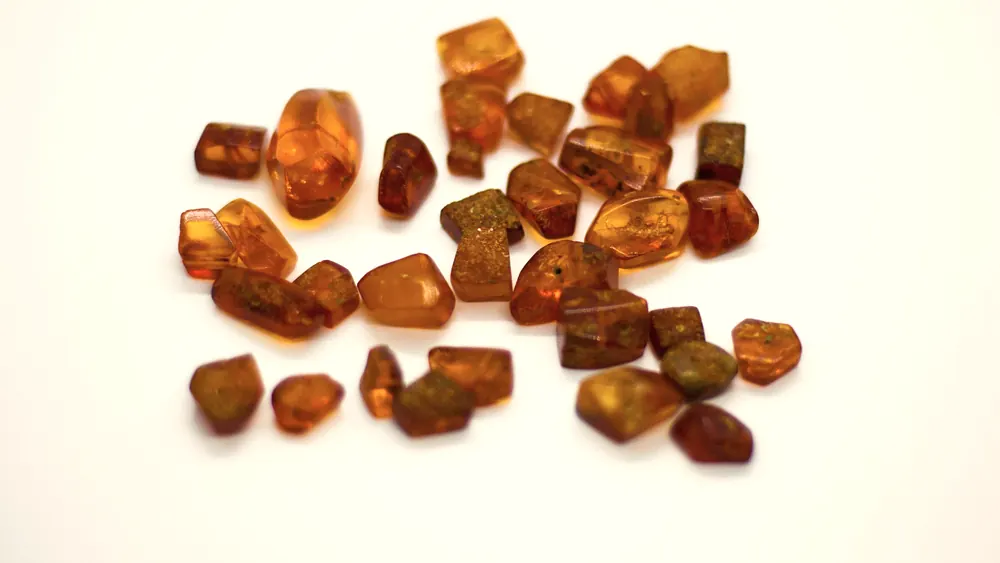
Amber is the worst-named material in perfumery. It is neither the fossil resin of jewellery nor the ambergris of the sperm whale: it is an accord, a construction. Perfumers obtain it by marrying resins — labdanum, benzoin — with vanilla, until they reach that powdery, slightly sweet warmth we recognise instantly without being able to name it.
Our data shows this unambiguously. In perfumes where amber dominates, the materials that come back most after amber itself are vanilla (100 pages), benzoin (64) and tonka bean (43). The amber accord is not a material one harvests, it is a recipe one repeats.
Of the 2,060 pyramid pages the catalogue held at publication, 801 carry an amber accord, i.e. 39% — nearly four perfumes in ten. But amber is almost never the subject there: it genuinely leads the composition in only 281 cases, i.e. 14%. That is the whole difference between a base that warms discreetly and a perfume one can call “an amber”.
Method. This selection is not a ranking of fame. We keep perfumes where amber is the dominant accord — the most intense of the composition, not merely present — and whose pyramid really contains an ambery material (amber, ambergris, labdanum, benzoin, incense, myrrh, resin). This double criterion answers a problem measured on other accords in the catalogue: a selection built on a single field surfaces perfumes whose accord is poorly recorded. A piece of data must be confirmed twice before being published. Ranked by amber intensity. Prices, where shown, are those recorded at our partner retailers on a bottle of at least 30 ml.
The founders — the classic oriental amber
The oldest dominant amber in the catalogue dates from 1925, the most recent from 2023: nearly a century apart. Few registers can say as much, and the two founders below are still worn.
Shalimar — Guerlain (1925, eau de parfum, feminine). The birth certificate of the genre. A citrus opening (bergamot, lemon, mandarin) that announces nothing of what follows, a floral heart of rose, jasmine and iris, then the tipping point: vanilla, incense, tonka bean, leather and benzoin. A hundred years later, the structure “bright citrus on a dark vanilla base” remains the very definition of the oriental.
Opium — Yves Saint Laurent (1977, eau de parfum, feminine). Spicier, more frontal. Mandarin, pepper and star anise in the top, cinnamon and orange blossom in the heart, then vanilla, incense, labdanum, amber and leather. Where Shalimar envelops, Opium asserts. Around €84 a bottle — one of the few classics of this standing to remain affordable.
Resinous, dry amber — without sugar
This is the most demanding reading of the register: keep the resins, remove the gourmandise.
Ambre Sultan — Serge Lutens (2000, eau de parfum, unisex). The most intense amber in the whole catalogue. A bewildering herbal opening — coriander, oregano, bay — before a heart of amber, incense and myrrh, and a base of vanilla, patchouli and white musk. Oregano on an amber is the kind of idea that can only be invented once.
Interlude Man — Amouage (2012, eau de parfum, masculine). Bergamot, pepper and oregano, then incense, oud and leather, on a base of amber and patchouli. A smoky, dense amber that does not try to please quickly.
Vanilla amber — the gourmand face
Grand Soir — Maison Francis Kurkdjian (2016, eau de parfum, unisex). The clearest demonstration of what an amber accord really is: benzoin, labdanum and orange blossom in the heart, vanilla, tonka bean and sandalwood in the base. No exotic material, no effect — just the classic recipe, executed without detours.
Ambre Interdit — Olfactive Alchimie (extrait, unisex). Sweet amber and vanilla from the opening, benzoin and tonka bean in the heart, labdanum in the base. An amber embraced to the end, without contrast. Around €65, which is little for an extrait.
Woody amber — the contemporary reading
For about ten years, amber has been combined mostly with wood. This is the register that dominates recent releases.
Baccarat Rouge 540 — Maison Francis Kurkdjian (2015, eau de parfum, unisex). Saffron and almond, jasmine and amberwood, then cedar, ambergris and white musk. Seven notes, a minimal design, and a signature that became so recognisable it started a school. The extrait released in 2017 takes up the same weave, denser.
Ambre Nuit — Dior (2009, eau de parfum, unisex). Bergamot and pepper, a rose in the heart, then ambergris, patchouli, incense and guaiac wood. The amber is held by the rose rather than by vanilla — hence an elegant dryness quite rare in the register.
Oud Satin Mood — Maison Francis Kurkdjian (2015, eau de parfum, unisex). Violet and saffron, rose and oud, vanilla, amber and benzoin. The bridge between amber and oud, for those who find oud alone too austere.
If you are discovering the register
Three remarks drawn from the pages above.
Amber is not a season, it is a temperature. These compositions carry far and last long — that is their nature, resins and vanilla are heavy materials. They therefore behave better in cold weather, where body heat diffuses them without saturating them. On this point, see also our guide to autumn and winter perfumes.
The declared gender matters little. In this selection, most pages are unisex, and the two founders are labelled feminine although they are now worn without distinction. The label tells you the era of the launch, not the contents of the bottle.
Start with a vanilla amber. It is the way in: vanilla softens the resins and makes the register instantly legible. The dry ambers — Ambre Sultan, Interlude Man — require some familiarity with the genre. Our guide to vanilla perfumes is a natural continuation of this one.
For some of the perfumes mentioned, the notes, years and concentrations are taken from unofficial sources (not from the house); the relevant page says so.