
Storing your perfumes: what really damages them
A perfume does not expire on a fixed date, it degrades. Three factors do most of the damage, and the place where many people keep their bottles is the worst in the house.
A perfume is a fragile solution: aroma materials suspended in alcohol. It oxidises, it evaporates, it changes. A badly stored bottle can become unrecognisable in eighteen months; well stored, it easily lasts five to ten years.
The stakes are not trivial. Our price surveys put the median bottle of eau de parfum at €95 and that of extrait at €114. A large bottle ruined is a fifty-euro note thrown away.
The four enemies
1. Light
It is one of the first factors of degradation. UV breaks down aroma molecules and makes the colour of the liquid turn — a pale perfume that darkens is a perfume that is oxidising.
The gesture: keep the perfume in its original box. It is not decorative packaging, it is protection. If you throw the box away, store the bottle in a closed drawer or cupboard.
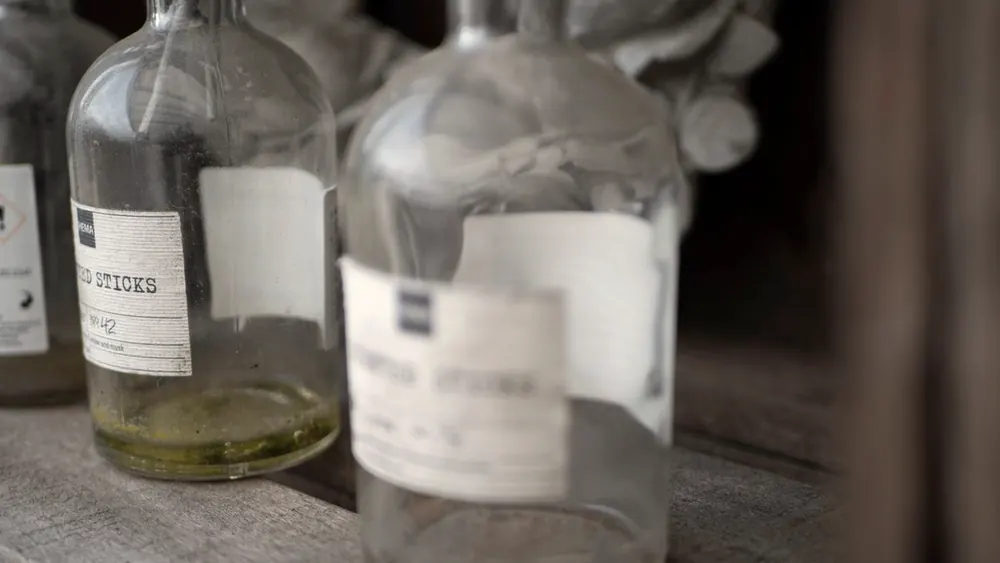
Clear, transparent bottles are the most exposed; dark or opaque bottles protect better. It is a criterion rarely mentioned at purchase, and it matters.
2. Heat and temperature swings
Heat accelerates all chemical reactions, hence degradation. But swings are often worse than heat alone: each hot/cold cycle works the liquid and the air trapped in the bottle.
The gesture: a place with a stable temperature. A bedroom or a hallway does the job perfectly.
3. Air
With each spray, air enters the bottle and gradually oxidises the contents. This is unavoidable with an atomiser, but much worse with a simple stopper that you open and close.
Counter-intuitive consequence: a half-empty bottle can degrade faster than a full one, because it contains more air. That is why buying small and finishing it is often smarter than buying big.
4. Time
Even perfectly stored, a perfume evolves. The top notes — the most volatile — leave first. An old bottle of hesperidic loses its opening and seems “flat”: this is consistent with what our analysis of pyramids shows, where bergamot, lemon and mandarin appear 100% as top notes.
Conversely, an amber or a heavy woody, built on tenacious base materials, ages far better. Some even improve, gaining in roundness.
The mistake almost everyone makes
The bathroom is the worst place in the house to keep a perfume.
It combines the first three factors: heat from showers, abrupt temperature swings several times a day, and humidity. Yet that is where most bottles are found.
Move them. It is the most profitable gesture on this page, and it is free.
And the fridge?
The idea circulates a lot. It is generally a bad one.
Stable cold does slow oxidation. But a domestic fridge imposes constant swings between 4 °C and room temperature — exactly the cycle of variation to avoid. Add to that humidity and food odours.
A wine cellar at a fixed temperature would be technically ideal. A dark, dry cupboard is almost as good, for zero euros.
How long does a perfume keep?
There is no expiry date in the food sense. The usual benchmarks:
- Sealed bottle, well stored: 5 to 10 years without noticeable problems.
- Opened bottle, well stored: 3 to 5 years.
- Opened bottle in a bathroom: 1 to 2 years before perceptible alteration.
- Hesperidic and aquatic: the most fragile, they go first.
- Ambers, woodies, orientals: the most resistant.
The signs that a perfume has turned: the colour has clearly darkened, the opening smells of alcohol or vinegar, or the overall odour has become “flat” and unrecognisable. A turned perfume is no longer of interest, and it is better not to wear it: some very common compounds (limonene, linalool) form allergenic substances as they oxidise, which can irritate the skin.
The case of samples and decants
Small vials degrade much faster: an unfavourable air-to-liquid ratio, often non-airtight containers, thin and sometimes transparent glass.
Consider that a decant should be used up within months, not years.
The recap
- Take your perfumes out of the bathroom. The most profitable gesture, and free.
- Keep them in their box, or out of the light.
- Stable temperature, neither radiator nor windowsill, nor fridge.
- Buy the size you will finish. A 100 ml at the best price per millilitre is a bad buy if it turns half full.
- Finish the hesperidics first, keep the ambers — they wait better.
To choose a size suited to your real consumption, see our analysis of price per millilitre. The technical vocabulary used here is detailed in the glossary.